discovering business and user needs
PROJECT CHALLENGES
How can we seamlessly migrate 100+ medical team members to a new EMR while scaling patient volume by x60?
PROJECT GOALS
Risk-aversion
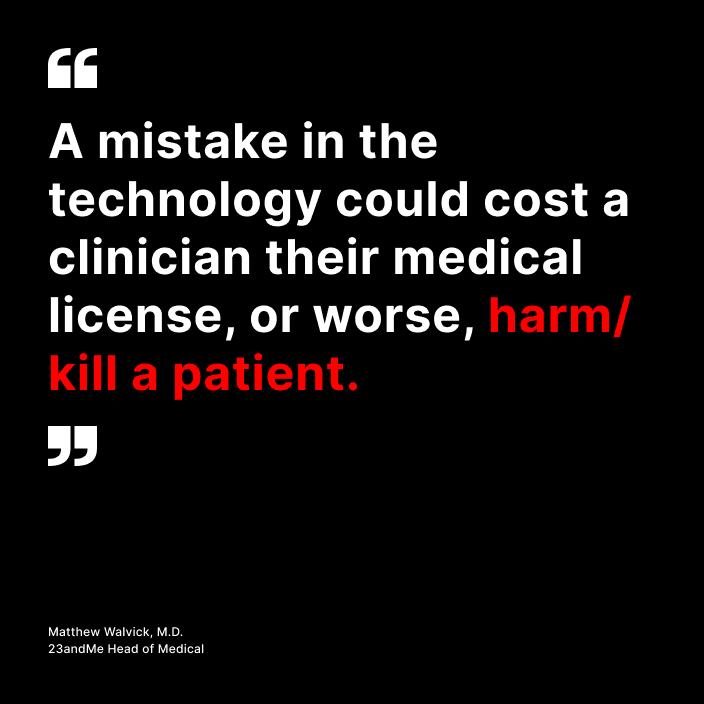
A mistake made by the software could cause a clinician to lose their medical license or worse: harming, or even killing, a patient. The medical team need a platform they can trust to deliver reliable, efficient care.
Efficiency
The medical team performs the same tasks and navigates the same flows daily. The medical team need design solutions that save them time so that they can interact with more patients.
design challenge
actually, that's not legal! 🧑⚖️
CHALLENGE
After aligning on the direction of the EMR, we brought in our Legal team who informed us that too much automation compromises our products largest limitation: our EMR was not a licensed medical device.
SOLUTION
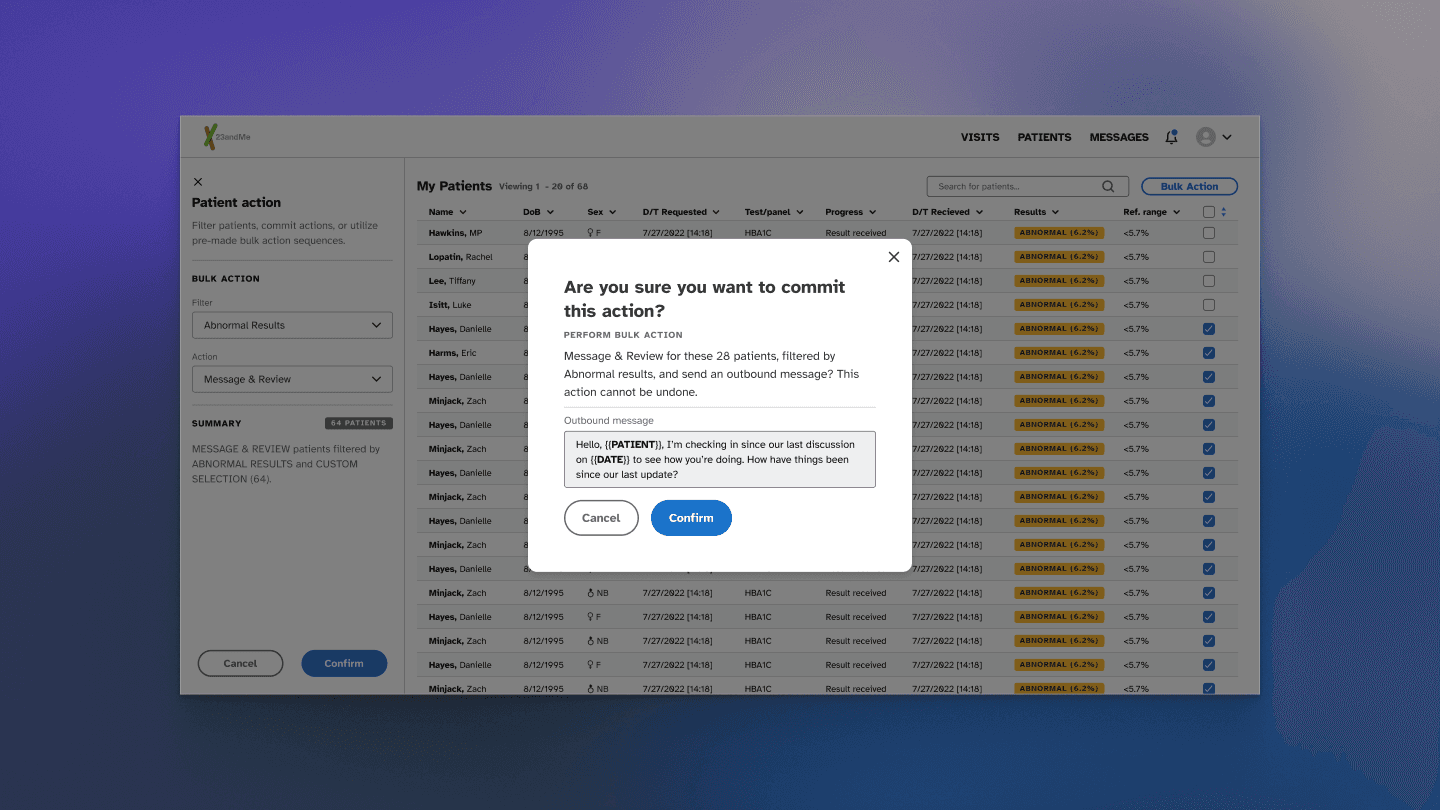
My team spent time learning the requirements of a medical device and exploring how we can operate around this restriction. We rolled back our automation solution to include some user intervention, requiring that the cinician manually submit the automation as a bulk action.
Hi-Fi mockup demonstrating simplified clinician UX.
proposing my solutions
While requirements were still being written, I saw an opportunity to bring automation into a flow that required little personalizaton. I proposed centralizing clinician operational automations within a single location separate from the standard patient care experience.

Next, I proposed automating the entire outbound message: replacing variables in each template with patient data stored within the EMR. The clinician could apply various filters to target specific patients, then release the outbound message in bulk. Stakeholders approved of this idea, and we named this process "Bulk Actions". Additional rounds of feedback revealed that floating surfaces could hide important information, again increasing risk of human error.
Exploring automated solutions
Wireframe for original automation design for Lab Tests.
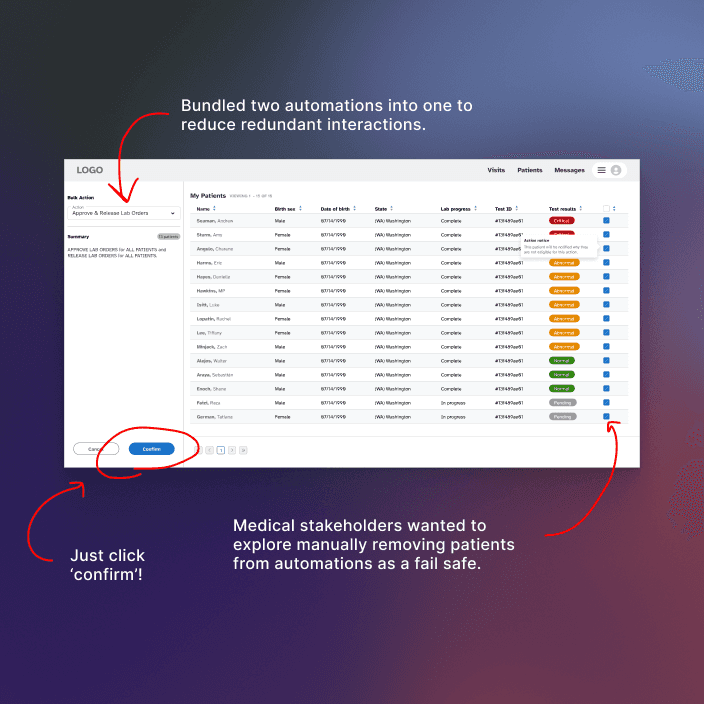
It turned out that by referencing stored patient information, we were able to automate even more than anticipated. The system would automatically deny inelligible patients based on demographic parameters, removing the need for clinician intervention. We began exploring solutions to automate the entire process for approving lab requests and releasing lab results. Our final proposal would reduce the 2,950 interactions per patient per flow to 1 interaction total!
Reducing clinician intervention to 1 interaction
Wireframe for approved automation, demonstrating Bulk Actions.
The first thing I explored was how to bring external medical team templates into the product (2-way messaging, outbound messages, after-visit summary, etc.). At first, I visualized this as a library of templated files that the medical team could insert into text fields and edit manually. While stakeholders liked this direction, it was brought to my attention that too much personalization increases the risk of human error.
Reducing the tech ecosystem
Something like, this is a description
informing my design strategy
Utilized heuristic evaluation, contextual inquiry, and prototype usability testing to understand the legacy platform and lab testing service, existing medical team processes, and gather feedback on design ideas.
RESEARCH METHODS
RESEARCH GOALS
These methods were used to understand how the medical team interacts with patients; identify inefficiencies in medical processes; and help make our project goals more tangable.
RESEARCH RESULTS
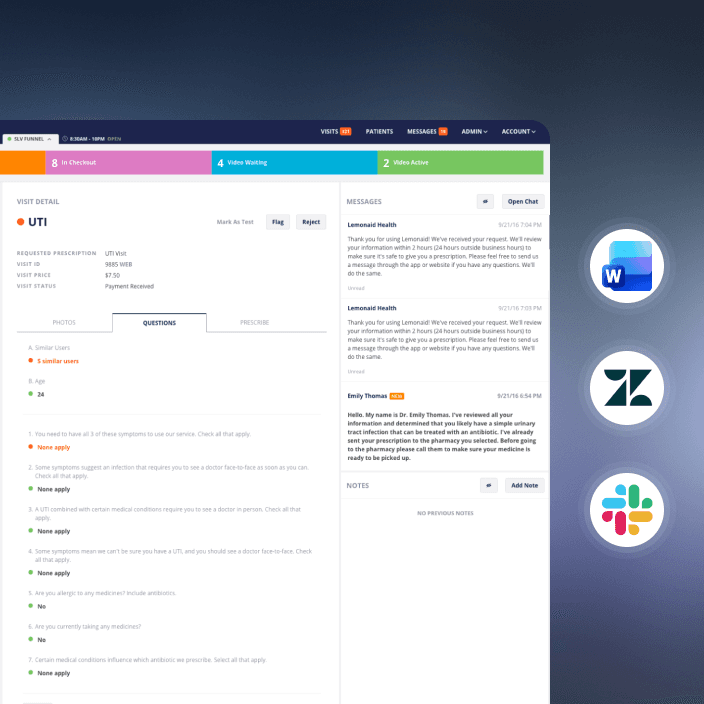
The medical team utilized many different platforms beyond the legacy EMR, context switching between 3-5 windows including Zendesk, Microsoft Word, and more. Medical team utilized templates for patient communication, but spent large efforts in customizing messages. The process of sending the patient a lab test was in two parts: accepting/denying the patient request and releasing the lab test results. Each process required approximately 2,950 interactions (clicks, scrolls) per patient.
In the legacy EMR, clinicians used at least 4 windows per lab test operation.
impact and reflection

23andMe's lab testing employee pilot launch (employees, family, and friends) yielded ~30 orders per week (updated 6/12/2026), reducing lab order clinician effort from 3hr/week to 2min/week, saving a projected 154 clinician hours annually.
Projected to save 154 clinician hours annually
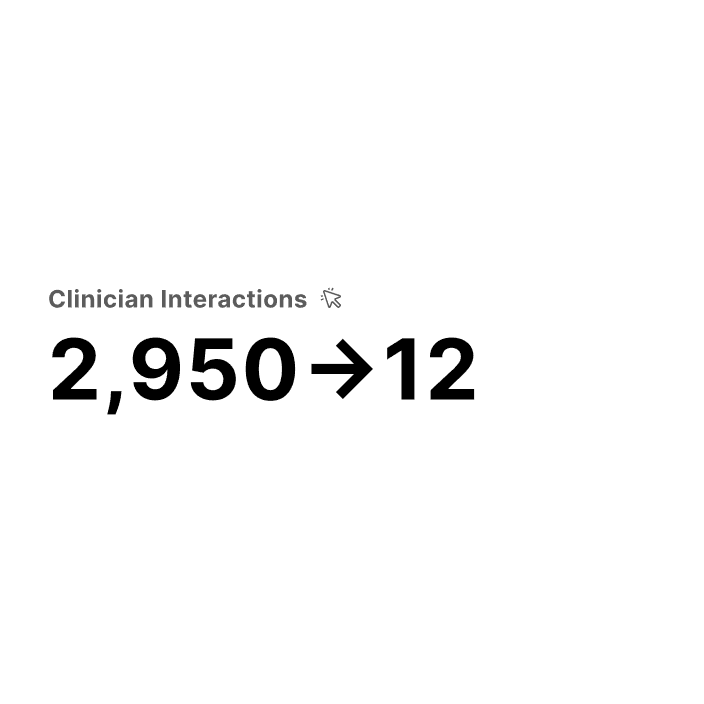
Our automated solution reduced the amount of clinician interactions from 2,950 interactions per process per patient to 12 total interactions per operation per patient.
-99.6% medical team interactions for lab-related tasks
Two of our project constraints (human error and regulated environments) were more than just challenges—they were real fears for my team and me. When our technology can hurt someone, exploring creative solutions felt like risk. By inviting our medical team and legal team into our core whiteboarding sessions, my core team was able to fill gaps in our experiences and reduce risk while aligning all our stakeholders.
Leaning on domain experts and treating legal as product partners

23ANDME
Clinical Portal: Lab Testing Employee Pilot
OVERVIEW
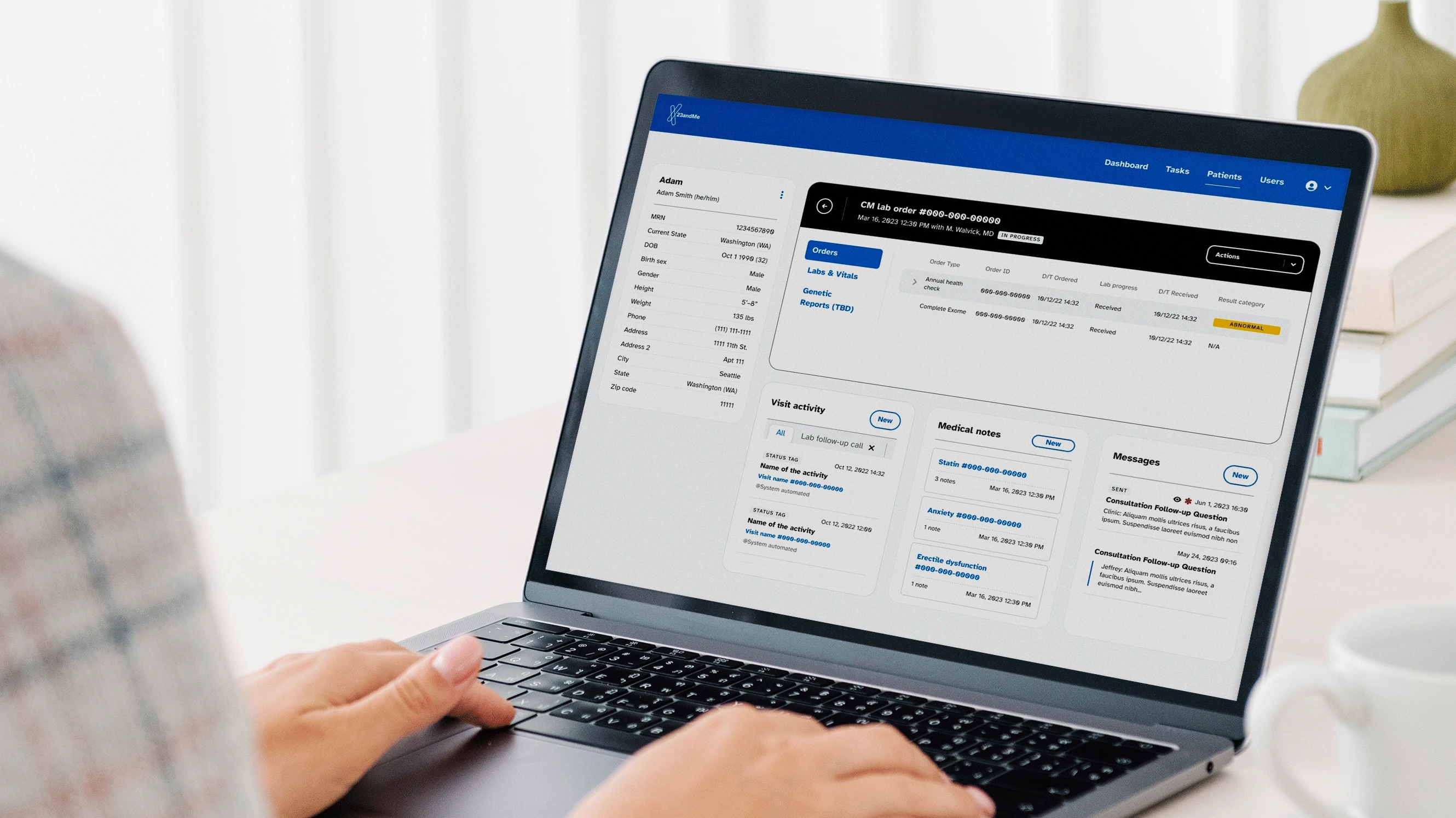
End-to-end design for the clinician-facing Electornic Medical Record (EMR) system. Strategized and launched a platform that enabled clinicians to treat patients at scale within a regulated environment.
ROLE
End-to-end product design
DURATION
2021-2022
TEAM
1 PD (me), 3 PM Leads, 4 Medical Team Leads, 2 (ENG) Team Leads, 2 Principal Engineers, 2 Front-end Engineers... and many more.
about the project
about the project
After acquiring Lemonaid Health Inc. in 2021, 23andMe began redefining its product strategy, pivoting into personalized healthcare. By prioritizing disease prevention, 23andMe aimed to help patients understand their genetic predispositions and deliver tailored guidance to reduce and even eliminate health risks.
Our first attempt at this new direction was through the introduction of at-home blood lab testing. Stakeholders were divided with some calling for automation to account for 23andMe's 18M customers, while others called for better personalization to improve the quality of patient care.
I was tasked with designing an in-house EMR in this company-wide endeavor, migrating the medical team, and sunsetting the legacy EMR platform used at Lemonaid Health.
After acquiring Lemonaid Health Inc. in 2021, 23andMe began redefining its product strategy, pivoting into personalized healthcare. By prioritizing disease prevention, 23andMe aimed to help patients understand their genetic predispositions and deliver tailored guidance to reduce and even eliminate health risks.
Our first attempt at this new direction was through the introduction of at-home blood lab testing. Stakeholders were divided with some calling for automation to account for 23andMe's 18M customers, while others called for better personalization to improve the quality of patient care.
I was tasked with designing an in-house EMR in this company-wide endeavor, migrating the medical team, and sunsetting the legacy EMR platform used at Lemonaid Health.


discovering business and user needs
PROJECT CHALLENGES
How can we seamlessly migrate 100+ medical team members to a new EMR while scaling patient volume by x60?
PROJECT GOALS
Risk-aversion
A mistake made by the software could cause a clinician to lose their medical license or worse: harming, or even killing, a patient. The medical team need a platform they can trust to deliver reliable, efficient care.
Efficiency
The medical team performs the same tasks and navigates the same flows daily. The medical team need design solutions that save them time so that they can interact with more patients.
informing my design strategy
RESEARCH METHODS
Utilized heuristic evaluation, contextual inquiry, and prototype usability testing to understand the legacy platform and lab testing service, existing medical team processes, and gather feedback on design ideas.
RESEARCH GOALS
These methods were used to understand how the medical team interacts with patients; identify inefficiencies in medical processes; and help make our project goals more tangable.
RESEARCH RESULTS
The medical team utilized many different platforms beyond the legacy EMR, context switching between 3-5 windows including Zendesk, Microsoft Word, and more. Medical team utilized templates for patient communication, but spent large efforts in customizing messages. The process of sending the patient a lab test was in two parts: accepting/denying the patient request and releasing the lab test results. Each process required approximately 2,950 interactions (clicks, scrolls) per patient.
proposing my solutions
While requirements were still being written, I saw an opportunity to bring automation into a flow that required little personalizaton. I proposed centralizing clinician operational automations within a single location separate from the standard patient care experience.
Reducing the tech ecosystem
The first thing I explored was how to bring external medical team templates into the product (2-way messaging, outbound messages, after-visit summary, etc.). At first, I visualized this as a library of templated files that the medical team could insert into text fields and edit manually. While stakeholders liked this direction, it was brought to my attention that too much personalization increases the risk of human error.
Exploring automated solutions
Next, I proposed automating the entire outbound message: replacing variables in each template with patient data stored within the EMR. The clinician could apply various filters to target specific patients, then release the outbound message in bulk. Stakeholders approved of this idea, and we named this process "Bulk Actions". Additional rounds of feedback revealed that floating surfaces could hide important information, again increasing risk of human error.

Reducing clinician intervention to 1 interaction
It turned out that by referencing stored patient information, we were able to automate even more than anticipated. The system would automatically deny inelligible patients based on demographic parameters, removing the need for clinician intervention. We began exploring solutions to automate the entire process for approving lab requests and releasing lab results. Our final proposal would reduce the 2,950 interactions per patient per flow to 1 interaction total!
design challenge
actually, that's not legal! 🧑⚖️
CHALLENGE
After aligning on the direction of the EMR, we brought in our Legal team who informed us that too much automation compromises our products largest limitation: our EMR was not a licensed medical device.
SOLUTION
My team spent time learning the requirements of a medical device and exploring how we can operate around this restriction. We rolled back our automation solution to include some user intervention, requiring that the cinician manually submit the automation as a bulk action.
impact and reflection
-99.6% medical team interactions for lab-related tasks
Our automated solution reduced the amount of clinician interactions from 2,950 interactions per process per patient to 12 total interactions per operation per patient.
Projected to save 154 clinician hours annually
23andMe's lab testing employee pilot launch (employees, family, and friends) yielded ~30 orders per week (updated 6/12/2026), reducing lab order clinician effort from 3hr/week to 2min/week, saving a projected 154 clinician hours annually.
Leaning on domain experts and treating legal as product partners
Two of our project constraints (human error and regulated environments) were more than just challenges—they were real fears for my team and me. When our technology can hurt someone, exploring creative solutions felt like risk. By inviting our medical team and legal team into our core whiteboarding sessions, my core team was able to fill gaps in our experiences and reduce risk while aligning all our stakeholders.
other case studies
23ANDME
Clinical Portal: Lab Testing Employee Pilot
OVERVIEW
End-to-end design for the clinician-facing Electornic Medical Record (EMR) system. Strategized and launched a platform that enabled clinicians to treat patients at scale within a regulated environment.
ROLE
End-to-end product design
DURATION
2021-2022
TEAM
1 PD (me), 3 PM Leads, 4 Medical Team Leads, 2 (ENG) Team Leads, 2 Principal Engineers, 2 Front-end Engineers... and many more.
End-to-end design for the clinician-facing Electornic Medical Record (EMR) system. Strategized and launched a platform that enabled clinicians to treat patients at scale within a regulated environment.
OVERVIEW
1 PD (me), 3 PM Leads, 4 Medical Team Leads, 2 (ENG) Team Leads, 2 Principal Engineers, 2 Front-end Engineers... and many more.
TEAM
Clinical Portal: Lab Testing Employee Pilot
23ANDME
End-to-end product design
ROLE
2021-2022
DURATION
about the project
After acquiring Lemonaid Health Inc. in 2021, 23andMe began redefining its product strategy, pivoting into personalized healthcare. By prioritizing disease prevention, 23andMe aimed to help patients understand their genetic predispositions and deliver tailored guidance to reduce and even eliminate health risks.
Our first attempt at this new direction was through the introduction of at-home blood lab testing. Stakeholders were divided with some calling for automation to account for 23andMe's 18M customers, while others called for better personalization to improve the quality of patient care.
I was tasked with designing an in-house EMR in this company-wide endeavor, migrating the medical team, and sunsetting the legacy EMR platform used at Lemonaid Health.